Pfahlgründungen in horizontal geschichteten Bodenprofilen -
Impedanzen, seismisches Verhalten und Bewegungen unter
dynamischer Belastung
PILAX21 berechnet im Frequenzbereich unter Verwendung
der Methode der dünnen Schichten (Thin Layer Method)
auf der Basis der elastischen Theorie
–
geeignet für Windows 11 und Linux
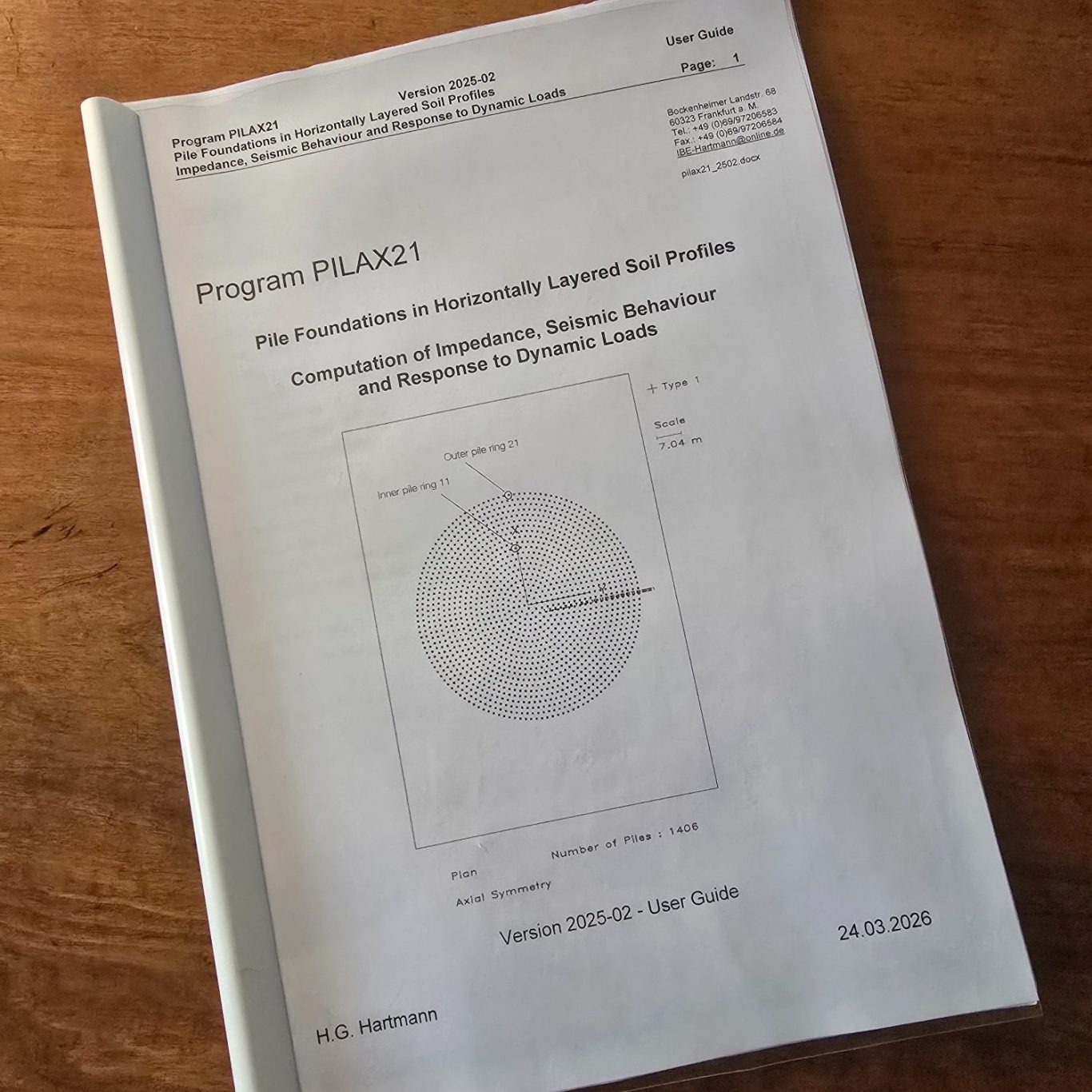
Hocheffiziente Software für Baugrunddynamik
PILAX21 bietet eine wissenschaftlich fundierte Analyse der Impedanzen von Pfahlgründungen in horizontal geschichteten Bodenprofilen.
Programmbeschreibung
1. Zweck
PILAX21 ist ein Computerprogramm, das im Frequenzbereich die Impedanzen und Pfahlkräfte von Pfahlgründungen in horizontal geschichteten Bodenprofilen sowie deren Antwort auf vertikal einfallende seismische Wellen (kinematische Interaktion) berechnet. Mit PILAX21 werden die Horizontal- , Vertikal- , Kipp- und Torsionsimpedanzen ermittelt. Die zugrunde liegende Theorie des Programms ist in [1] beschrieben. Die verwendete Methode verbindet die Fähigkeit, komplexe Phänomene zu berücksichtigen, mit effizienten und schnellen Lösungsalgorithmen.
2. Methode
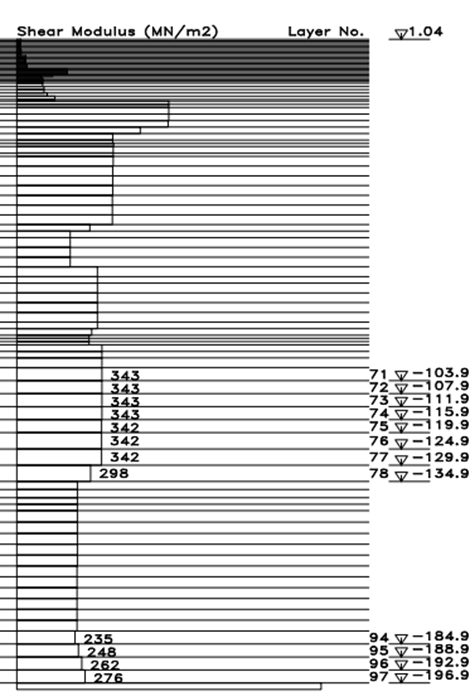
Der geschichtete Boden wird als linear-elastisch oder visko-elastisch angenommen. Die Schichten liegen auf einem starren oder elastischen Halbraum. Der elastische Halbraum wird durch mehrere zusätzliche Schichten repräsentiert, deren Dicke frequenzabhängig ist. Zusätzlich kann an der Unterseite entweder eine einfache Dämpfungsgrenze (nach Kuhlemeyer/Lysmer [4]) oder eine spezielle Dämpfungsgrenze (nach Kausel [5]) angeordnet werden.
Zur Herleitung der Greenschen Funktionen im horizontal geschichteten Boden wird die effektive und vielseitige Thin-Layer-Methode (TLM) in der Formulierung von Waas [2], [3] verwendet. Das geschichtete Kontinuum wird in vertikaler Richtung im Sinne der Finite-Element-Methode diskretisiert. In horizontaler Richtung werden analytische Lösungen des Kontinuumsproblems genutzt (Hankel- und Bessel-Funktionen).
Im Allgemeinen werden starre Pfahlkopfplatten angenommen. Die Berechnung aufgehender flexibler Bauwerksstrukturen kann in einem allgemeinen FE-Programm in einem weiteren Schritt außerhalb von PILAX21 durchgeführt werden. Im Spezialfall starrer Bauwerksstrukturen erlaubt PILAX21 die direkte Eingabe dynamischer Lasten und berechnet die resultierenden Übertragungsfunktionen für einen oder mehrere Pfahlkopfplatten bzw. Gebäude. Die berechneten Impedanzen oder Übertragungsfunktionen enthalten implizit die Ausbreitung von Raumwellen (Kompressions- und Scherwellen) sowie Oberflächenwellen (Rayleigh- und Love-Wellen) im Untergrund, ohne Störungen durch Reflexionen an künstlichen Modellgrenzen. Bei Kopplung mit Gebäudemodellen wird die kinematische Interaktion zwischen Bauwerk und Boden infolge der Massenträgheit vollständig erfasst.
Die linearen Analysen werden im Frequenzbereich durchgeführt. Nichtlineares Bodenverhalten um einen Pfahl kann näherungsweise durch zusätzliche Federn zwischen Pfahl und Bodenschichten berücksichtigt werden. Ein Sekantenmodulverfahren kann zur iterativen Berechnung verwendet werden (äquivalent lineare Analyse). Die Belastung kann aus statischen und dynamischen horizontalen oder vertikalen Kräften, vorgegebenen Verschiebungen oder vertikal einfallenden seismischen Wellen bestehen. Als Antwort werden Pfahlkräfte, Verschiebungen und Beschleunigungen berechnet. Die vertikalen Pfähle werden durch Timoshenko-Balkenelemente modelliert. Die Pfahlköpfe können an der Pfahlkopfplatte eingespannt oder gelenkig angeschlossen sein. Auch mehrere voneinander getrennte Pfahlkopfplatten sind möglich, was die Berücksichtigung der dynamischen Interaktion mehrerer Gebäude auf Pfahlgründungen erlaubt.
Zur Reduzierung des Rechenaufwands bei der Lösung der Gleichungen werden zwei Maßnahmen ergriffen:
a) Anwendung der Flexibilitätsmethode anstelle der Steifigkeitsmethode und
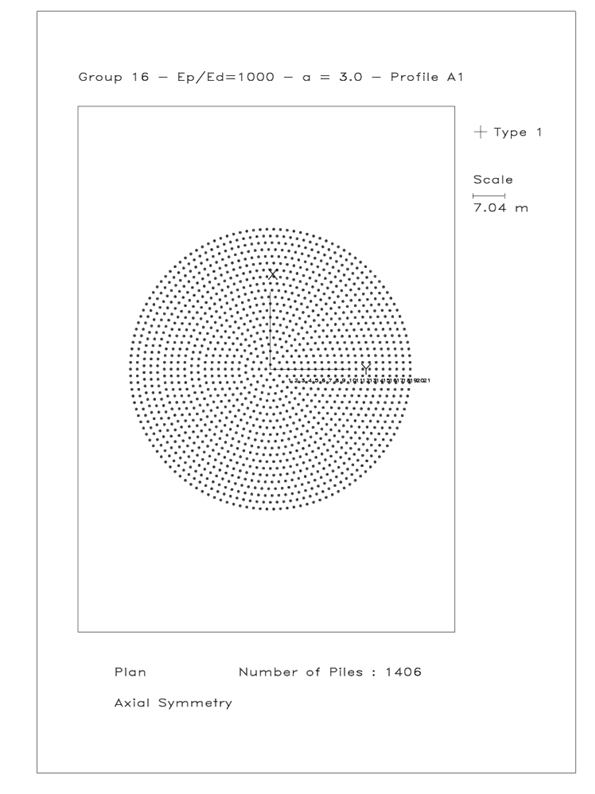
b) Nutzung einfacher und doppelter Symmetrie bzw. zyklischer Periodizität, siehe auch [1].
Die Impedanz einer starren Pfahlkopfplatte ist definiert als die komplexe dynamische Steifigkeitsmatrix im Frequenzbereich, formuliert für sechs Freiheitsgrade (DOF). Die komplexwertigen Matrixelemente repräsentieren Amplituden und Phasen harmonischer Bewegungen bei gegebenen Frequenzen. Die Matrix enthält die Kopplung der Freiheitsgrade, den Einfluss von Steifigkeit, Dämpfung und Masse des Bodens sowie die Abstrahlungsdämpfung. Das bedeutet, dass Energie im Untergrund durch Kompressions- und Scherwellen sowie durch Oberflächenwellen an Schichtgrenzen und insbesondere an der Geländeoberfläche abgestrahlt werden kann.
Im Fall von NCAP starren Pfahlkopfplatten besitzt die komplexe Steifigkeitsmatrix die Dimension DOF = 6 × NCAP, einschließlich aller Kopplungsterme.
Im Fall einer flexiblen Pfahlkopfplatte wird NCAP = NR gesetzt, wobei NR die Gesamtzahl der Pfähle ist. Dies führt zu einer vollständigen Steifigkeitsmatrix der Dimension DOF = 6 × NR, die außerhalb von PILAX21 mit einem FE-Modell der Pfahlkopfplatte gekoppelt werden kann.
PILAX21 und zugehörige Nachbearbeitungsprogramme berechnen im Detail:
Impedanzmatrix einer oder mehrerer Pfahlgründungen mit starrer Pfahlkopfplatte (formatierte Ergebnisse in <file>.imp). Diese Matrizen können als Fundamentsteifigkeiten in allgemeinen FE-Programmen verwendet werden.
Frequenzabhängige Verschiebungen der Pfahlköpfe infolge harmonischer Lasten, vorgegebener Verschiebungen oder seismischer Anregung (formatierte Ergebnisse in <file>.cap).
Frequenzabhängige Verschiebungen und innere Kräfte der Pfähle infolge harmonischer Lasten, vorgegebener Verschiebungen oder seismischer Anregung (unformatierte oder formatierte Ergebnisse in <file>.dis, <file>.for und <file>.str).
3. Kinematische und trägheitsbedingte Interaktion bei seismischer Anregung
Für seismische Analysen von Gebäuden auf Pfählen führt die Annahme einer starren Pfahlkopfplatte zu einer erheblichen Vereinfachung der Berechnung. Das Gesamtproblem kann in zwei Teilprobleme zerlegt werden: das der kinematischen und der trägheitsbedingten Interaktion sowie das der Pfahlgründung und des Überbaus, siehe Abb. 1.
In PILAX21 können Pfahlverschiebungen und innere Kräfte aufgrund kinematischer und trägheitsbedingter Interaktion berechnet werden.
4. Erschütterungen durch externe Quellen (Induzierte Anregung)
Erschütterungen durch externe Quellen können modelliert werden, indem harmonische Lasten an einer starren Platte (mit oder ohne Pfähle) angesetzt werden. Diese Stelle repräsentiert einen Emissionsort von Schwingungen, z.B. ein Maschinenfundament oder einen Gleiskörper. Die Schwingungsantwort wird an einer benachbarten Pfahlkopfplatte beobachtet, wobei auch hier die Annahme einet starren Platte zu einer erheblichen Vereinfachung führt. Das Gesamtproblem kann wieder in zwei Teilprobleme zerlegt werden: das der kinematischen und der trägheitsbedingten Interaktion sowie das der Pfahlgründung und des Überbaus, siehe Abb. 2.
5. Plot-Optionen
Die Geometrie der Pfahlgründungen und des geschichteten Bodenmodells sowie die Verschiebungen, inneren Kräfte und Spannungen der Pfähle können mit dem Programm PILPLO21 grafisch dargestellt werden.
6. Referenzen
[1] Hartmann, H.G. : "Pfahlgruppen in geschichtetem Boden unter horizontaler dynamischer Belastung", Mitteilungen des Instituts für Grundbau, Boden- und Felsmechanik der technischen Hochschule Darmstadt, Heft 26, April 1986, https://nbn-resolving.org/urn:nbn:de:tuda-tuprints-268832, https://doi.org/10.26083/tuprints-00026883
[2] Waas, G. : "Dynamisch belastete Fundamente auf geschichtetem Baugrund",
VDI-Berichte Nr. 381 (1980)
[3] Waas, G. et al. : "Displacement solutions for dynamic loads in transversely-isotropic stratified media", Earthquake Engineering and Structural Dynamics, Vol 13, pgs. 173-193 (1985) , https://doi.org/10.1002/eqe.4290130204
[4] Tabatabaie-Raissi, M. : "The flexible volume method for dynamic soil-structure interaction analysis", Ph.D. Dissertation, University of California, Berkeley (1982)
[5] Seals, S.H. and Kausel, E. : "Dynamic loads in the interior of cross-anisotropic, layered halfspaces", Int. Journal of Solids and Structures (1986)
[6] Rangelow, P., Richter, T., Nincic, V., Kosbab, B., García, J.A., Hartmann, H.G. and
Johansson, J.: Benchmark Study on Impedance Functions of Large Pile Foundations, Transactions, Division III, D3-S7, SMiRT-25, Charlotte, NC, USA, August 4-9, 2019
[7] Hartmann, H.G.: Induzierte Erschütterungen von Bauwerken auf Pfahl- und auf Flachgründungen – Ein Vergleich über numerische Berechnungen, Geotechnik 3/2024, https://doi.org/10.1002/gete.202400015
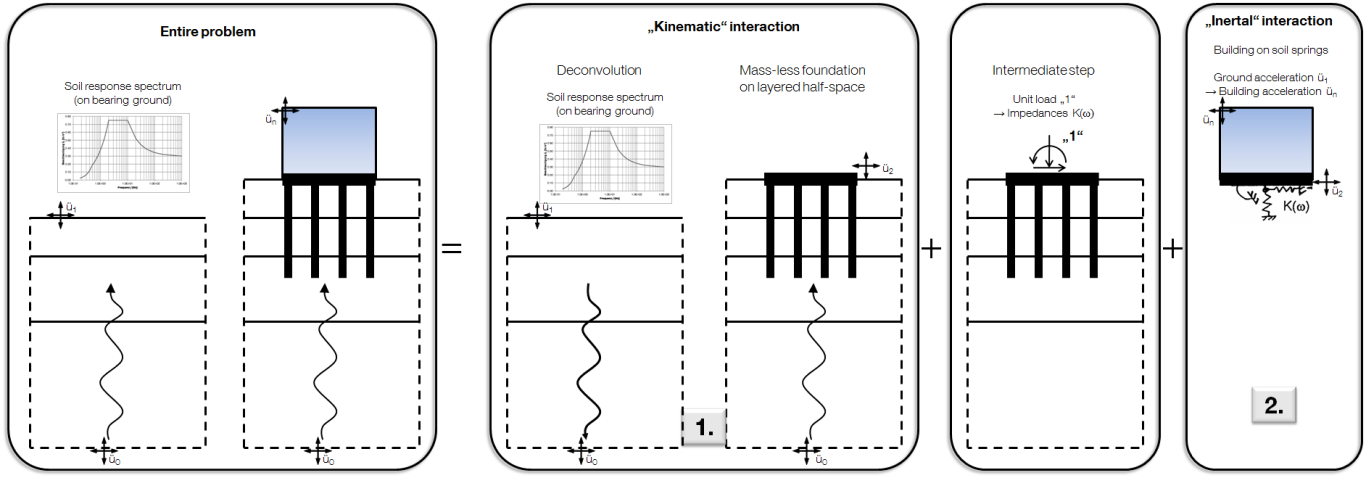
Fig. 1: Bauwerk auf Pfahlgründung unter seismischer Anregung – Superpositionsschema
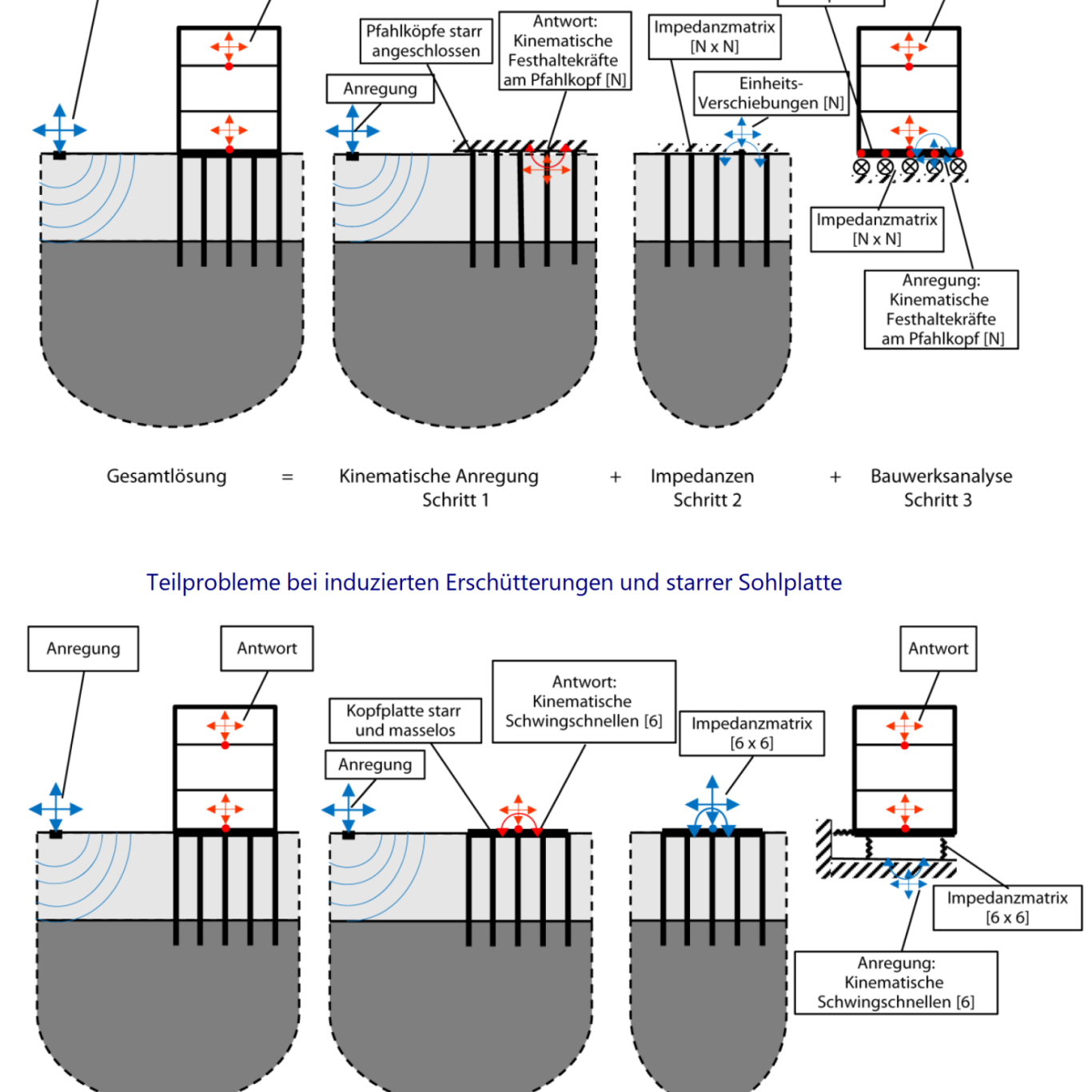
Fig. 2: Bauwerk auf Pfahlgründung unter induzierter Anregung – Superpositionsschema
bei flexibler (oben) und starrer (unten) Pfahlkopfplatte
Hinweise zur Anwendung
PILAX21 läuft sicher und stabil unter Windows 11 und verschiedenen Linux-Distributionen.
1. Verifikationen
PILAX21 wurde sorgfältig entwickelt und getestet. Es wurde in zahlreichen Anwendungen erfolgreich für Pfahl-Boden-Bauwerks-Interaktionsanalysen eingesetzt. Mit PILAX21 erzielte Ergebnisse wurden mit veröffentlichten Resultaten verglichen. Die Übereinstimmung war sehr zufriedenstellend [1].
2. Diskretisierung
Da Diskretisierungen verwendet werden, hängen die Ergebnisse von PILAX21 von deren Qualität ab. Im Allgemeinen können gute Resultate erwartet werden, wenn folgende Empfehlungen beachtet werden:
a) Die Schichtdicke h sollte kleiner als 1/8 der Scherwellenlänge λ sein, die von der Frequenz f abhängt:
h<1/8⋅λ=1/8⋅ vₛ /f
wobei vₛ die Scherwellengeschwindigkeit der Schicht ist. (Die Verschiebungen über jede Schicht variieren linear.)
b) Die Dicken zweier aufeinanderfolgender Schichten mit gleicher Wellengeschwindigkeit sollten sich nicht zu stark unterscheiden. Ein Faktor von 1,5 ist tolerierbar.
3. Numerische Zuverlässigkeit
Eine PILAX21-Analyse umfasst komplexe numerische Verfahren (z. B. Lösung linearer und quadratischer Eigenwertprobleme sowie Berechnung von Bessel-Funktionen mit komplexen Argumenten). Trotzdem sind numerische Probleme in mehreren hundert Anwendungen äußerst selten aufgetreten. Falls dennoch ein Problem auftritt, sollte zuerst die Eingabedatei überprüft werden.
Wenn bei der Berechnung der Eigenwerte (Unterprogramme LOVE und RAYLEIGH) keine Konvergenz erreicht wird, hilft meist eine kleine Änderung der Frequenz. Dies wird vom Programm automatisch durchgeführt.
Viele Bodenschichten mit gleicher Dicke und gleichen Materialeigenschaften (z.B. Halbraum) können zu einer Häufung höherer Wurzeln führen und die Konvergenz beeinträchtigen. Abhilfe schafft eine leichte Variation der Schichtdicken.
Bei hohen Frequenzen, z. B. über 20 Hz, können vertikale Ringlasten numerische Probleme verursachen, da der innere Boden-Zylinder in Resonanz geraten kann. Stattdessen können oberhalb einer bestimmten Frequenz FREGRE Kreisflächenlasten verwendet werden.
Die Dimension der Eigenwertprobleme steigt mit der Anzahl der Schichten. In typischen Anwendungen werden etwa 50 Schichten verwendet. Mehr als 100 Schichten wurden ohne numerische Probleme eingesetzt.
4. Numerischer Aufwand
Der Rechenaufwand steigt ungefähr:
quadratisch mit der Anzahl der Schichten bei der Lösung der Eigenwertprobleme,
linear mit der Anzahl der Schichten bei der Berechnung der Flexibilitätsmatrix der Grenzknoten,
quadratisch bis kubisch mit der Anzahl der Pfahlknoten.
Da die Inversion der Flexibilitätsmatrix den Aufwand kubisch mit der Anzahl der Pfahlknoten ansteigen ließe, wird im Programm die Flexibilitätsmethode anstelle der üblichen Steifigkeitsmethode verwendet.
5. Größenbeschränkungen
Die Algorithmen zur Erzeugung und Lösung der Matrixgleichungen sind als In-Core-Operationen implementiert. Größere Probleme können daher virtuellen Speicher erfordern. Periphere Speicherbereiche werden für Ausgabedateien (Druck- und Plot-Ausgaben) sowie für den Datenaustausch mit anderen Programmen genutzt.
Die Größe der mit PILAX21 analysierbaren Probleme wird durch verfügbaren Speicher, Rechenleistung und Laufzeit begrenzt. Es ist auch möglich, dass numerische Schwierigkeiten die Größe einschränken. In zahlreichen Anwendungen wurden jedoch keine derartigen Grenzen erreicht.